
Morgan Wallen, Hardy, Eric Church Debut “McArthur” Collaboration

- Morgan Wallen, Eric Church, Tim McGraw, and HARDY have unveiled a new collaboration titled “McArthur.”
- The song was teased through cryptic Instagram posts outlining four generations of a fictional family from 1920 to 2025.
- “McArthur” explores legacy and inheritance, anchored by the lyric, “when you pass on, what you gonna pass down?”
- The multi-artist release arrives tonight and signals a rare, narrative-driven collaboration in modern country music.
“McArthur” Is Country Music Looking at Itself in the Mirror
When Morgan Wallen, Eric Church, Tim McGraw, and HARDY revealed they were releasing a song together called “McArthur,” the reaction wasn’t just excitement—it was recognition. Recognition that something unusually deliberate was happening in a genre often driven by speed, singles, and streaming math.
The rollout didn’t rely on a chorus tease or radio push. Instead, it unfolded through a series of cryptic, interconnected posts mapping out the lives of a fictional family across generations. Dates. Names. Deaths. One survivor still standing. Fans weren’t just listening—they were decoding.
Collaborations of this scale don’t happen often in country music, and when they do, they usually arrive with clear commercial intent. “McArthur” doesn’t feel built that way. It feels closer to a statement—about legacy, time, and what gets carried forward when voices change hands.
What Is “McArthur”?
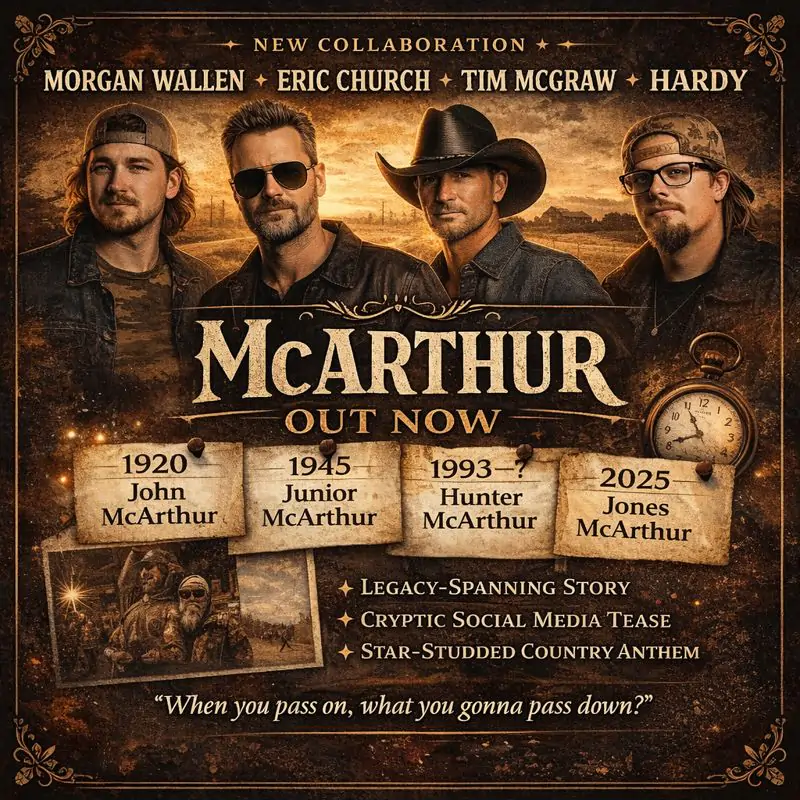
At its core, “McArthur” is a narrative song built around a fictional, multi-generational family whose lives stretch from the early 20th century to the present day. Each generation is represented by one of the four artists involved, creating a living timeline rather than a traditional feature-heavy collaboration.
The song isn’t framed as a duet or a supergroup flex. It’s a shared story, told from multiple vantage points, unified by one central question: what do we leave behind when our time is done?
Rather than centering on a single moment, “McArthur” treats history as something inherited—values, mistakes, pride, land, bloodlines. The family name becomes a vessel for broader themes: American identity, masculine legacy, mortality, and the quiet weight of continuity.
Decoding the McArthur Family Timeline
The rollout introduced four members of the McArthur family, each tied to specific dates that quietly anchor the song in real-world context.
John McArthur – Tim McGraw
Born in 1920 and dying in 1963, John McArthur represents the patriarchal generation shaped by war, post-war rebuilding, and rigid definitions of duty. Tim McGraw’s association with this character makes intuitive sense. McGraw has spent decades embodying country music’s bridge between traditional values and emotional openness, often returning to themes of fatherhood and responsibility.
Junior McArthur – Eric Church
Junior’s life spans from 1945 to 1967, a period marked by upheaval and generational rupture. Assigned to Eric Church, this chapter feels pointed. Church has long positioned himself as country music’s internal critic—questioning authority, resisting polish, and exploring disillusionment. Junior McArthur’s shortened lifespan mirrors that tension, suggesting conflict rather than comfort.
Jones McArthur – HARDY
Born in 1968 and dying in early 2025, Jones represents the most volatile chapter. HARDY’s creative identity—split between country songwriting craft and hard-edged rock disruption—fits a character shaped by contradiction. Jones feels like the generation that absorbed the past but struggled to reconcile it, carrying both tradition and rebellion.
Hunter McArthur – Morgan Wallen
Hunter, born in 1993 with no death date listed, is the living voice. Morgan Wallen steps into the role of inheritance itself—the generation still deciding what to keep, what to discard, and what to redefine. The alignment of Hunter’s birth year with Wallen’s own adds another layer, blurring the line between fiction and autobiography.
Together, these timelines form less of a plot than a lineage. The dates matter because they mirror the real-world eras that shaped modern country music itself.
Why These Four Artists — and Why Now
Each artist involved occupies a distinct place in country music’s ongoing story.
Tim McGraw stands as the legacy anchor. His career bridges the genre’s pre-digital past and its streaming-dominated present. His presence lends gravity and historical perspective, reminding listeners where the modern industry came from.
Eric Church functions as conscience and counterweight. He has consistently resisted trends, prioritizing albums over singles and narrative over formula. His involvement signals that “McArthur” is meant to be considered, not consumed casually.
Morgan Wallen represents the current center of gravity. As the genre’s most dominant commercial force, his participation ensures visibility—but his role here is notably restrained. Rather than driving the song toward mass appeal, Wallen appears positioned as the inheritor of its questions.
HARDY is the architect. As a songwriter deeply fluent in both Nashville tradition and modern disruption, he’s uniquely suited to construct a piece that feels old and new simultaneously. If there’s a guiding hand shaping “McArthur,” it’s likely his.
The timing matters because country music itself is at a crossroads—torn between algorithmic acceleration and a renewed appetite for meaning.
A Rare “Event Record” in Country Music
Country music has a long history of collaborative moments that feel bigger than individual careers. Projects like The Highwaymen, The Highwomen, and The Outlaws weren’t just collections of voices—they were reflections of their eras.
What makes “McArthur” feel similar isn’t the number of stars involved, but the intent. It’s not built around novelty or playlist placement. It’s built around perspective.
Moments like this have become rare because they require patience, restraint, and a willingness to prioritize narrative over metrics. That rarity is exactly why “McArthur” lands with such weight.
Lyrics, Sound, and Emotional Weight
The central lyric revealed ahead of release—“When you pass on, what you gonna pass down?”—functions as both thesis and refrain. It’s a question that lingers rather than resolves.
Musically, the song leans into restraint. The arrangement favors space and gradual build, allowing harmonies to stack without overwhelming the narrative. Each voice enters not to compete, but to extend the thought, creating a sense of communal reflection rather than individual performance.
The tone is elegiac, not explosive. Even at its emotional peak, “McArthur” resists the payoff-driven structure typical of radio hits. It sounds less like a climax and more like a reckoning.
Is “McArthur” the Start of Something Bigger?
Whether “McArthur” serves as an album opener, a standalone statement, or the seed of a larger collaborative project remains unconfirmed. What’s clear is that it doesn’t need a follow-up to justify its existence.
In an era where releases are often designed to feed momentum, “McArthur” feels comfortable standing alone. That autonomy is part of its power. By not chasing radio formats or streaming trends, the song positions itself outside the usual lifecycle.
If it leads to something more, it will be because the story demands it—not because the market does.
Why “McArthur” Matters for Country Music in 2026
Country music in 2026 exists in tension between scale and substance. The genre has never been bigger, but it’s also rarely paused to take stock of itself.
“McArthur” functions as that pause. It asks artists and listeners alike to consider lineage—not just of families, but of sounds, values, and storytelling traditions. It reminds the genre that growth doesn’t have to mean erasure.
In choosing reflection over immediacy, the song subtly challenges the algorithm-first approach shaping modern releases. It argues, quietly but firmly, that longevity still matters.
“McArthur” isn’t built to dominate a weekend. It’s built to endure. By weaving together four distinct voices into a single generational narrative, the song reframes collaboration as conversation rather than spectacle.
In doing so, it offers something increasingly rare: a piece of country music that feels aware of its past, grounded in its present, and thoughtful about its future. Long after the initial release moment fades, the question it poses will remain—waiting, like inheritance itself, to be answered.